Reference
Choosing an AVR for a generator
What an automatic voltage regulator does, the three ways they fail, and why the AVR is matched to the alternator rather than to the engine.
What it does
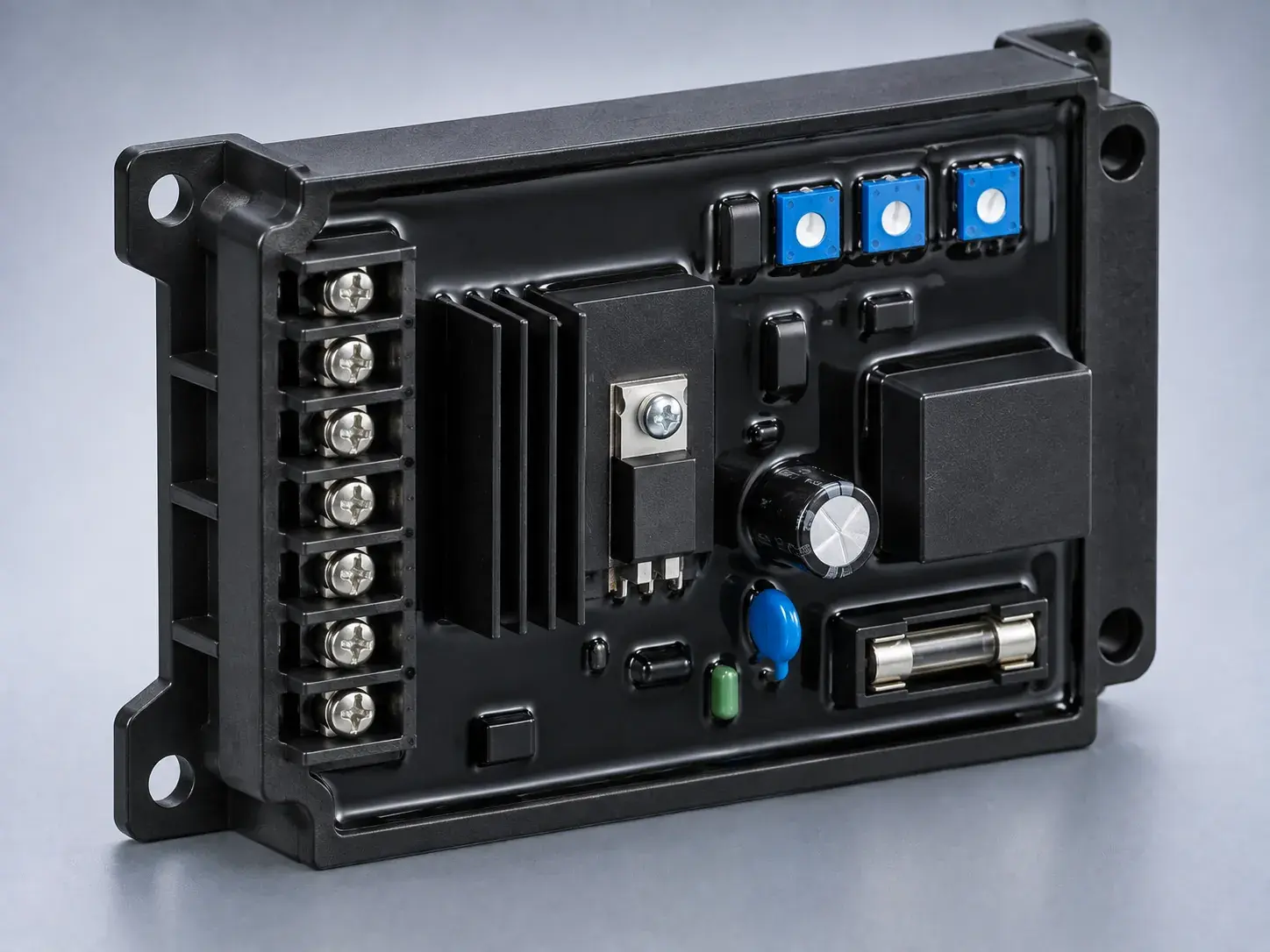
An automatic voltage regulator holds the alternator's output voltage steady as load comes on and off. It runs a closed loop: it measures the terminal voltage, compares it against a setpoint, and raises or lowers the excitation current going to the field to correct the difference.
That correction is continuous. Everything the set feeds depends on the AVR doing it quietly in the background, which is why an AVR fault shows up as damage to connected equipment rather than as an obvious fault on the set itself.
The three ways they fail
The first is no output. The engine runs at the right speed, the set sounds normal, and there is no electricity. This usually means the AVR has lost its ability to excite the field.
The second is unstable voltage. The output wanders, lamps dim and brighten, and bulbs and electronic equipment fail earlier than they should. A set behaving like this is doing slow damage to whatever it is feeding.
The third is the dangerous one. An AVR that fails wide open drives the excitation up and sends the voltage high, and it takes connected equipment with it. Before testing anything, it is worth simply looking at the board for scorch marks, swelling or a burnt smell, because a failure of this kind often leaves its evidence in plain sight.
Matched to the alternator, not the engine
An AVR belongs to the alternator, not to the engine in front of it. A Cummins engine says nothing about which regulator the set needs, because the same engine is coupled to alternators from several makers.
So the information that identifies a replacement is the alternator make and model, and the number off the existing regulator. The common families are the Stamford pattern, which includes the SX440, SX460, AS440 and MX341, and the Leroy Somer pattern, which includes the R230, R438, R448 and R450.
Before fitting a replacement
An AVR rarely dies of old age on its own. Check what killed it before fitting another, or you will fit two. Loose or corroded sensing leads, a diode failure in the rotating rectifier, and running the set badly out of its speed range all show up at the AVR.
Note the voltage setting and any stability adjustment on the old unit before removing it, where those are still readable. A replacement that is electrically correct but set differently will still need adjusting on commissioning, under load rather than off load.